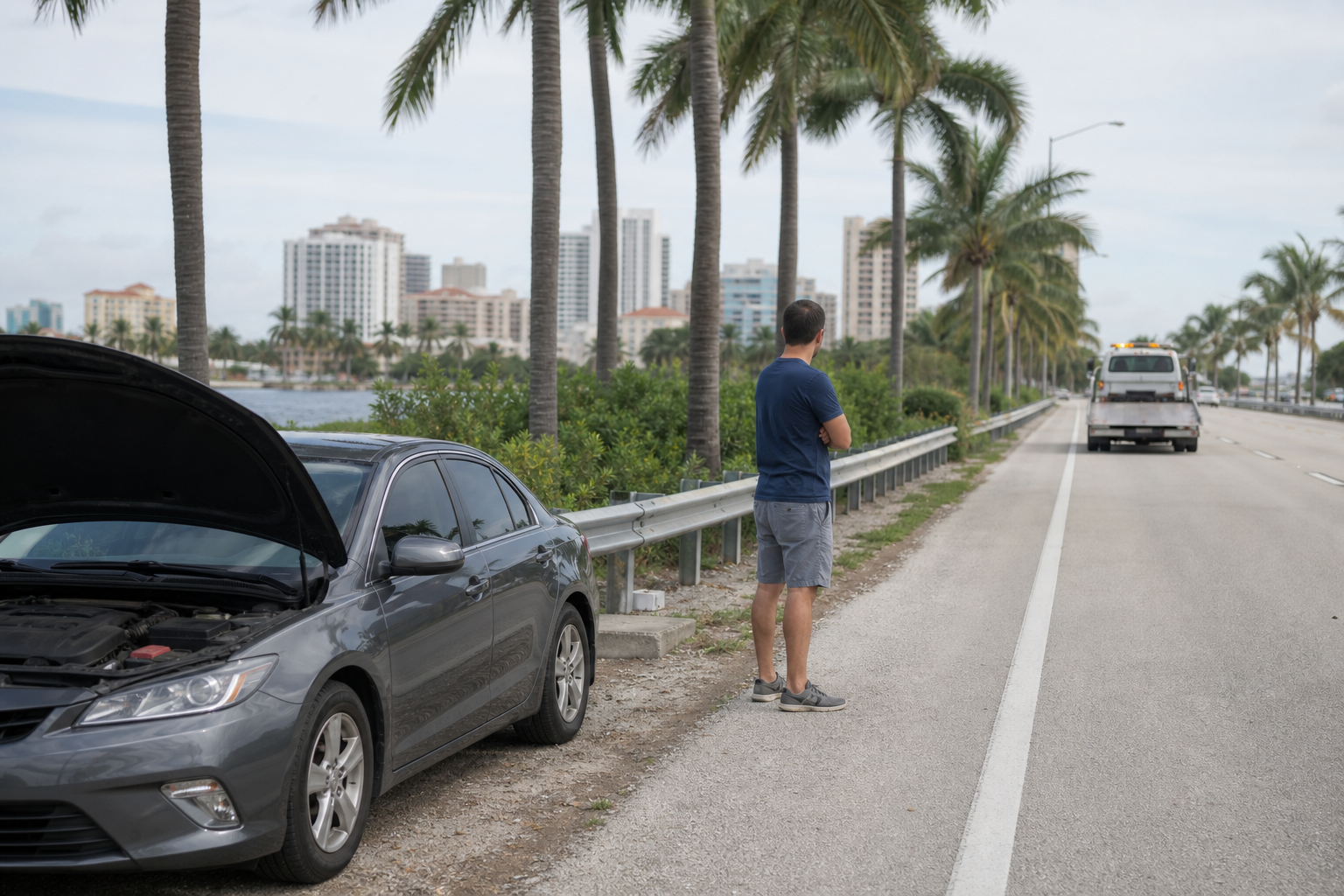
A vehicle problem does not always mean you need a tow. A low fuel warning, a dead battery, or a lockout may be handled with the right roadside assistance. But some symptoms make continued driving risky for you, your passengers, and nearby traffic. Knowing the difference can prevent a minor breakdown from becoming a collision or more serious vehicle damage.
In West Palm Beach, the decision can feel especially urgent on fast-moving routes and busy corridors such as I-95, Southern Boulevard, Okeechobee Boulevard, and US-1. South Florida heat, heavy rain, standing water, and dense traffic can make a disabled vehicle harder to manage safely. When in doubt, prioritize getting out of danger over trying to diagnose the vehicle on the roadside.
First: Protect Yourself Before Deciding What the Car Needs
- If you see flames, smell active burning, have smoke entering the cabin, are stopped in an active travel lane, or your vehicle creates an immediate traffic hazard, call 911. Do not wait for a tow provider to assess an emergency.
- If the vehicle still moves safely, use signals and move to the nearest safe location away from moving traffic. Avoid stopping on a narrow shoulder when a safer exit, parking lot, side street, or wider shoulder is reachable without worsening the problem.
- Turn on hazard lights. At night, during rain, or in poor visibility, make the vehicle as visible as possible without putting yourself in danger.
- Do not stand beside the vehicle, between the vehicle and traffic, or on a narrow shoulder near moving vehicles. If you can safely leave the vehicle, wait well away from traffic, ideally behind a barrier or in a protected area.
- Call for towing or roadside assistance once you are in the safest available position.
The Simple Decision Rule: Can the Vehicle Move Predictably and Stop Safely?
A car should generally be towed when it cannot be driven predictably, cannot stop reliably, is losing essential fluids rapidly, has a wheel or tire failure that affects control, or may cause additional damage if driven. You do not need to know the exact mechanical cause to make a safe decision. The important question is whether the vehicle can respond normally to steering, braking, acceleration, and shifting.
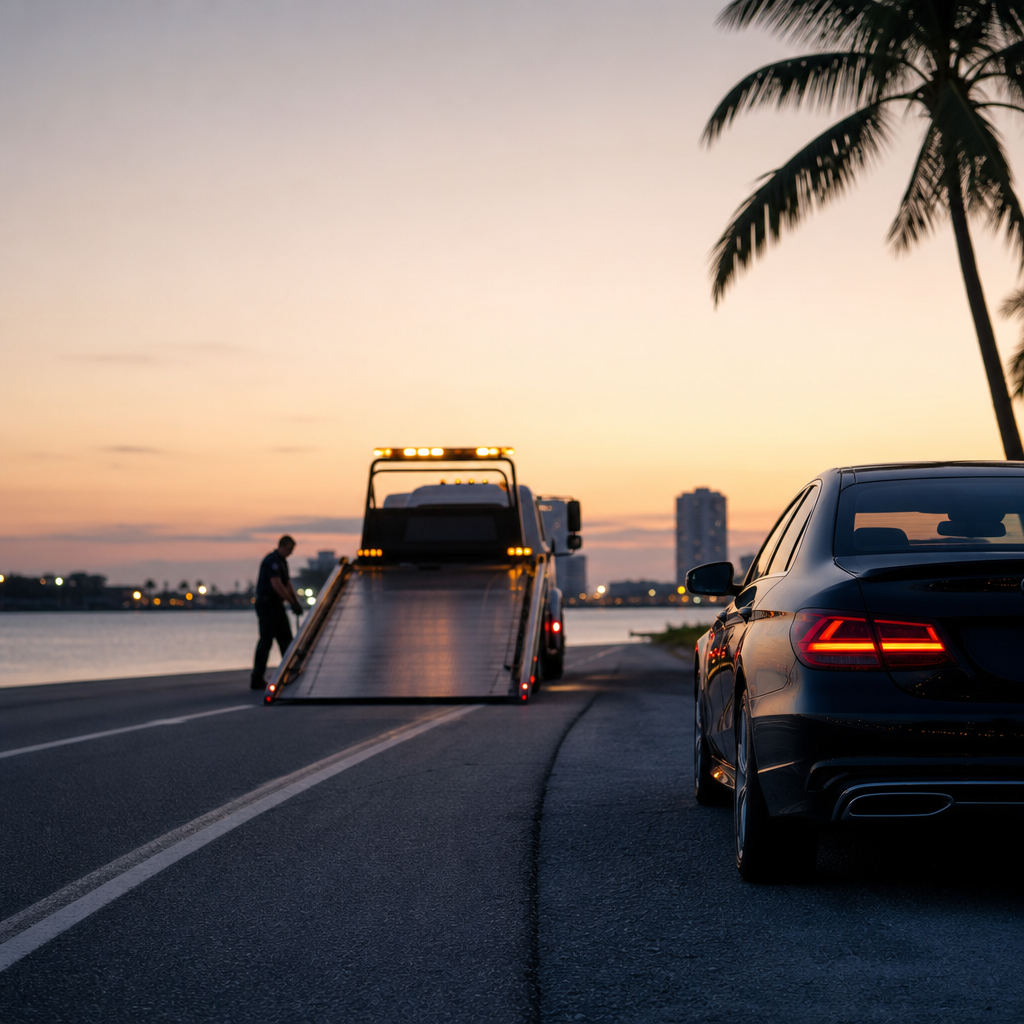
If your answer is no, arrange a tow rather than attempting to “make it home.” Short distances are not automatically safe distances. A few blocks on a damaged tire, overheating engine, or failing transmission can be enough to create a dangerous situation.
Symptoms That Usually Mean Stop Driving
1. The engine is overheating or losing coolant
Pull over and stop driving if the temperature gauge is in the hot range, an overheating warning appears, steam is coming from under the hood, or there is a strong sweet smell accompanied by coolant leaking beneath the vehicle. Florida heat can make an overheating condition worsen quickly, particularly in slow traffic or after a long drive.
Do not open a hot radiator cap or reach into the engine compartment. Let the vehicle cool and arrange towing. Continuing to drive an overheating vehicle can cause severe engine damage.
2. The oil-pressure light stays on or the engine makes loud knocking sounds
An oil-pressure warning is different from a routine maintenance reminder. If the oil-pressure light remains on while the engine is running, pull over as soon as it is safe and shut the engine off. Likewise, loud knocking, grinding, banging, or harsh metallic sounds from the engine are reasons not to continue driving.
A sudden loss of lubrication or internal engine damage can become worse quickly. A tow is the safer option than repeatedly restarting the vehicle or trying to drive to a nearby shop.
3. Brakes feel weak, the pedal sinks, or the vehicle pulls sharply when braking
Do not drive if the brake pedal goes unusually low, feels soft or spongy, requires pumping to work, or if the vehicle pulls hard to one side when braking. Grinding during braking, a brake warning light combined with poor braking response, or a burning smell near a wheel can also point to a condition that needs immediate attention.
If you can safely get off the roadway, do so carefully. If you cannot stop safely or are disabled in traffic, call 911.
4. Steering is difficult, loose, or unpredictable
A steering wheel that suddenly becomes very hard to turn, shakes severely, has excessive play, or pulls the vehicle strongly in one direction should not be ignored. Loss of steering assist can be especially difficult to manage during turns, lane changes, or low-speed maneuvering in traffic.
Stop in a safe place and request a tow. Avoid trying to compensate by driving slowly on busy streets; slow speed does not remove the risk of losing control around intersections or merging traffic.
5. A tire has failed, a wheel is damaged, or the car vibrates violently
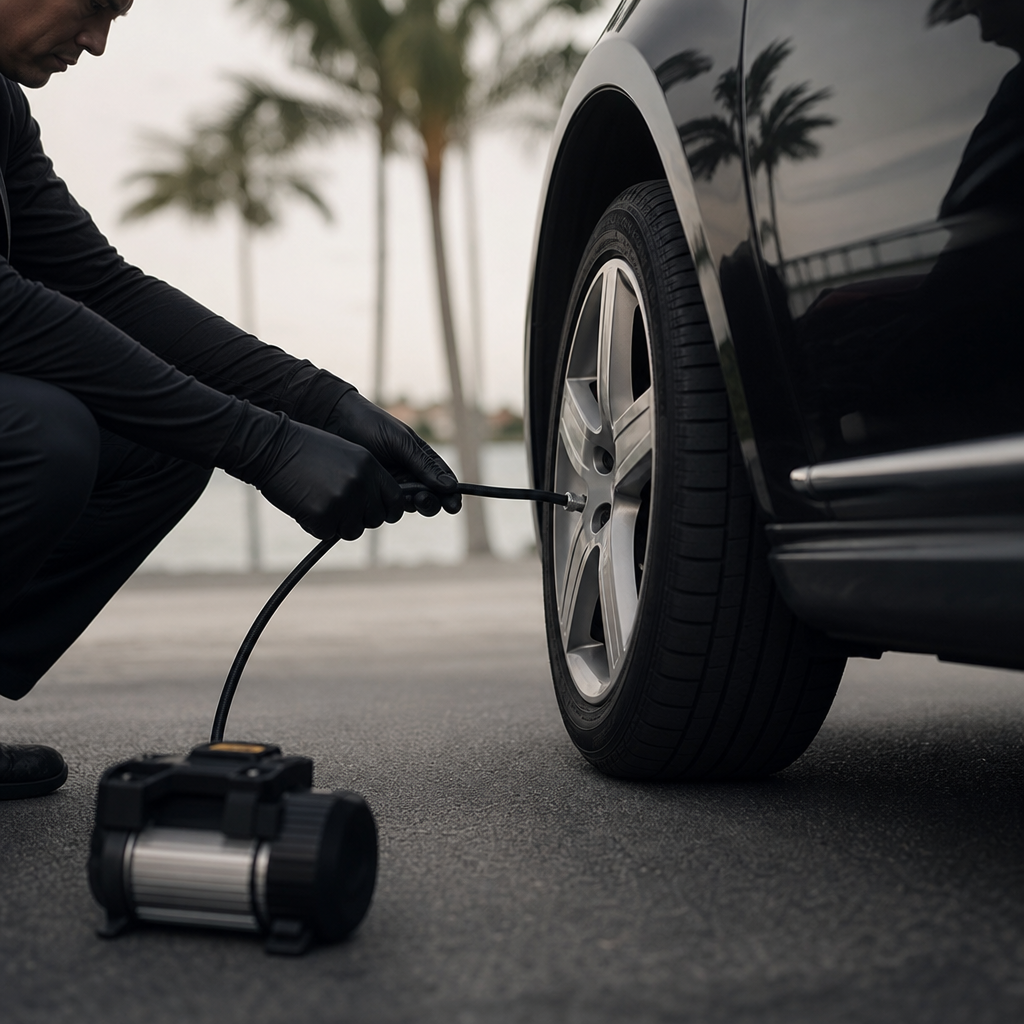
A flat tire may be manageable only if you can safely park away from traffic and have a usable spare, proper tools, and a safe place to work. On I-95, busy multilane roads, narrow shoulders, during heavy rain, or anywhere traffic is close to your vehicle, changing a tire yourself can be dangerous. Request roadside assistance for a flat tire or towing instead.
Call for a tow if the tire sidewall is damaged, the wheel appears bent or loose, the car has severe vibration, or you hear repeated thumping, scraping, or metal-on-metal noise from a wheel area. Do not drive on a flat tire simply to reach a service location.
6. The vehicle will not shift normally or cannot stay in gear
Transmission and drivetrain symptoms deserve caution. Stop driving if the vehicle will not shift into gear, slips out of gear, cannot remain in gear, suddenly loses the ability to accelerate normally, or makes severe clunking, whining, grinding, or banging sounds while moving.
Repeatedly forcing a shifter, revving the engine to overcome slipping, or attempting to nurse the vehicle through traffic can increase damage and leave you stranded in a worse location. A tow is the practical choice when the vehicle cannot move under normal control.
7. Warning lights appear with major changes in how the car drives
A dashboard light by itself does not always require towing. The situation changes when a warning light comes with rough running, loss of power, stalling, overheating, poor braking, harsh shifting, or unusual noises. For example, a flashing check-engine light paired with shaking or a major power loss is more urgent than a steady light on an otherwise normal-running vehicle.
If the vehicle feels unsafe or behaves differently in a serious way, stop driving and arrange help rather than relying on the warning light alone to tell you what is wrong.
Situations Where Roadside Assistance May Be Enough
Some breakdowns can be resolved where you are parked, provided the location is safe and the vehicle has no signs of a deeper mechanical issue. Common examples include a dead battery, a lockout, a simple flat-tire situation in a protected area, or running out of fuel.
- If the vehicle will not start but otherwise drove normally before you parked, a battery jump may be worth trying.
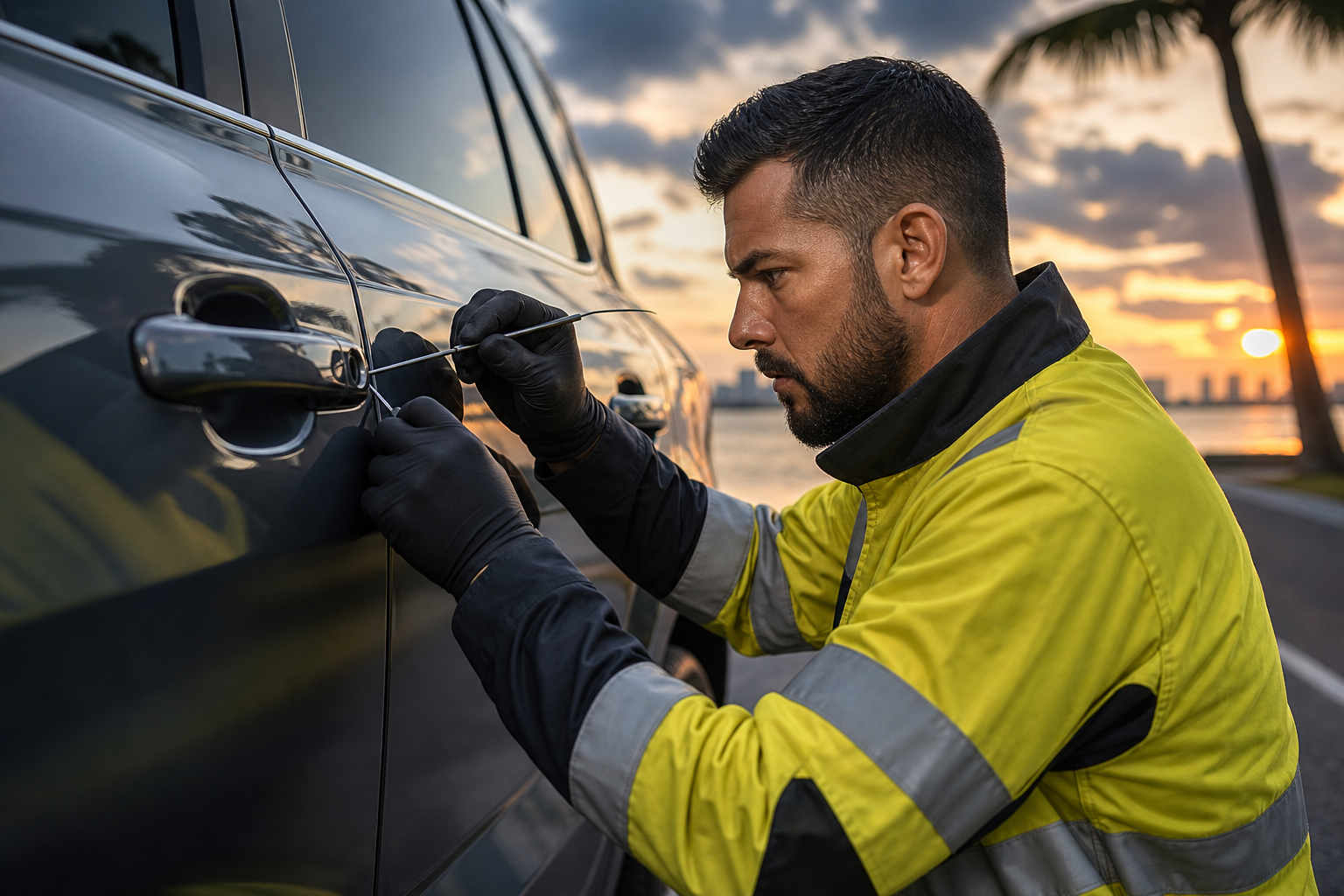
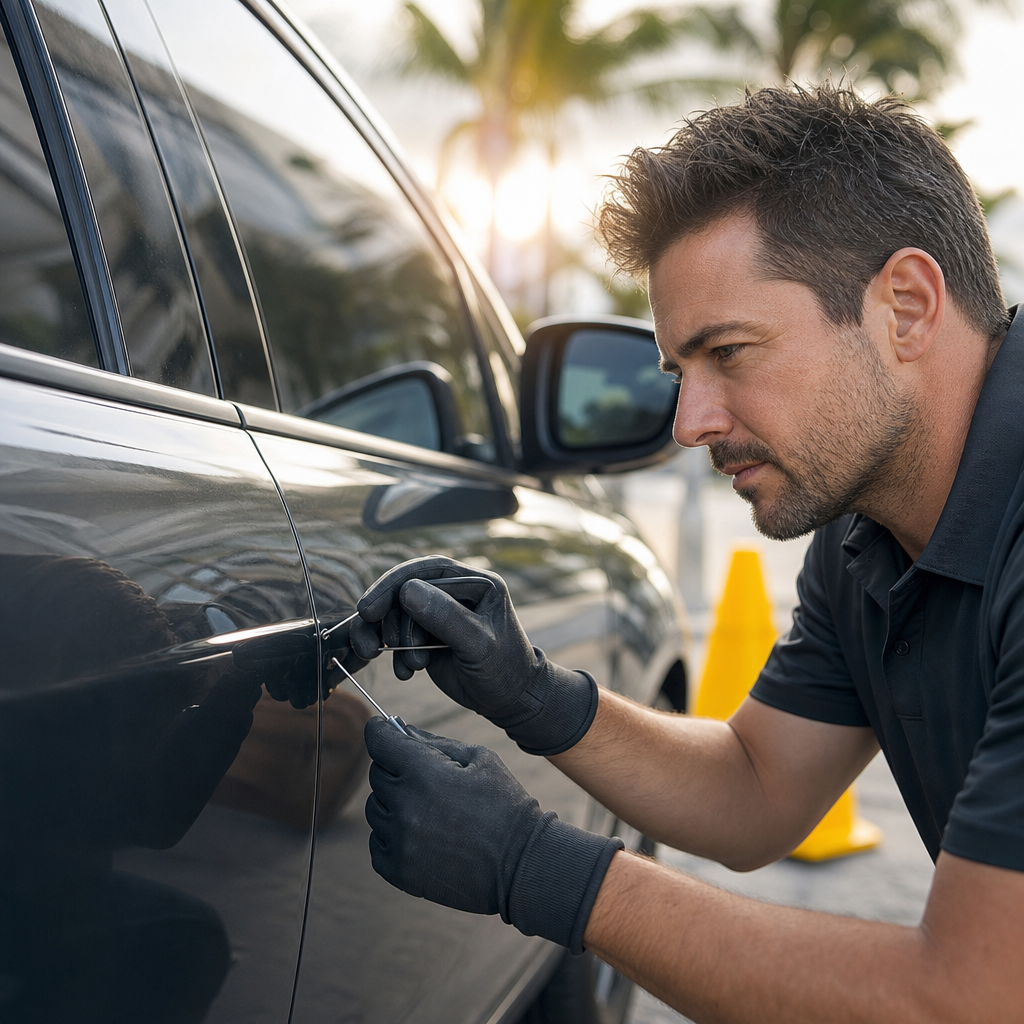
- If keys are locked inside the vehicle, use car lockout service rather than attempting to force a door or break a window.
- If a jump-start works but battery warnings remain on, lights dim, or the engine stalls again, avoid assuming the trip is safe to continue. Ask the roadside provider whether towing is the safer next step.
- If a flat occurs in an unsafe traffic location, the roadside location itself may make towing or professional help preferable to a roadside tire change.
West Palm Beach Roadside Safety Checklist
Use this checklist while waiting for help. It is designed for the practical conditions drivers encounter around West Palm Beach, including sudden rain, high heat, and busy arterial roads.
- Share your location using a nearby cross street, business, exit number, landmark, or travel direction. Do not rely only on “I am near West Palm Beach.”
- Tell the provider whether you are on I-95, a bridge approach, a ramp, a narrow shoulder, a parking lot, or a residential street. Access conditions affect the safest response.
- Keep hazard lights on if doing so does not create another issue.
- Stay out of travel lanes and avoid standing next to the driver-side door where passing vehicles may be close.
- During lightning, heavy rain, or intense heat, seek a safer sheltered location only if you can reach it without crossing active traffic.
- Take essentials with you if leaving the vehicle is safe: phone, identification, medications, water, and needed child-safety items.
- Do not accept help that requires you to stand in traffic, crawl beneath the vehicle, or make a roadside repair beyond your comfort and safety level.
When to Call for Help Right Away
Contact a towing or roadside provider immediately when the vehicle cannot be safely driven, when you are unsure whether it can be controlled, or when your location makes waiting dangerous. Explain the symptoms clearly: smoke, overheating, brake trouble, steering trouble, flat tire, inability to shift, drivetrain noise, stalled engine, or lockout.
For a non-emergency lockout in a safe place, request car lockout assistance. For a dead battery, tire issue, fuel problem, or other manageable roadside need, request roadside help. When the car has a serious mechanical, brake, steering, transmission, wheel, or overheating problem, tell the dispatcher you believe it needs towing.
Call 911 instead of waiting for towing assistance if there are visible flames, a vehicle disabled in an active travel lane, an immediate crash risk, injuries, or another urgent traffic hazard. Once emergency responders have addressed the immediate danger, you can coordinate towing from the safer location.
Frequently Asked Questions
Can I drive a short distance with an overheating engine?
It is safer not to. If the temperature gauge is high, steam is visible, or an overheating warning appears, stop driving as soon as you can safely pull over. Continuing even a short distance can increase engine damage.
Should I tow my car if it will not shift into gear?
Yes, towing is usually the safer choice if the vehicle will not shift, slips out of gear, cannot stay in gear, or makes severe drivetrain noises. These problems can leave the vehicle unable to accelerate or move predictably in traffic.
Is it safe to wait inside my car on the shoulder?
It depends on the location. On a narrow shoulder beside fast traffic, do not stand outside next to the vehicle. If you can safely move to a protected place away from the roadway, do so. If you are disabled in an active lane or face an immediate traffic hazard, call 911.
Does a check-engine light always mean I need a tow?
No. A steady check-engine light without drivability problems may not require immediate towing. However, a flashing light or any warning light combined with shaking, stalling, smoke, overheating, loss of power, or unusual noises is a reason to stop and seek help.
What information should I give a towing or roadside provider?
Give your exact location, direction of travel if applicable, vehicle make and model, the symptom you noticed, whether the vehicle is movable, and whether you are in a safe parking area or near traffic. Clear details help the provider prepare for the situation.