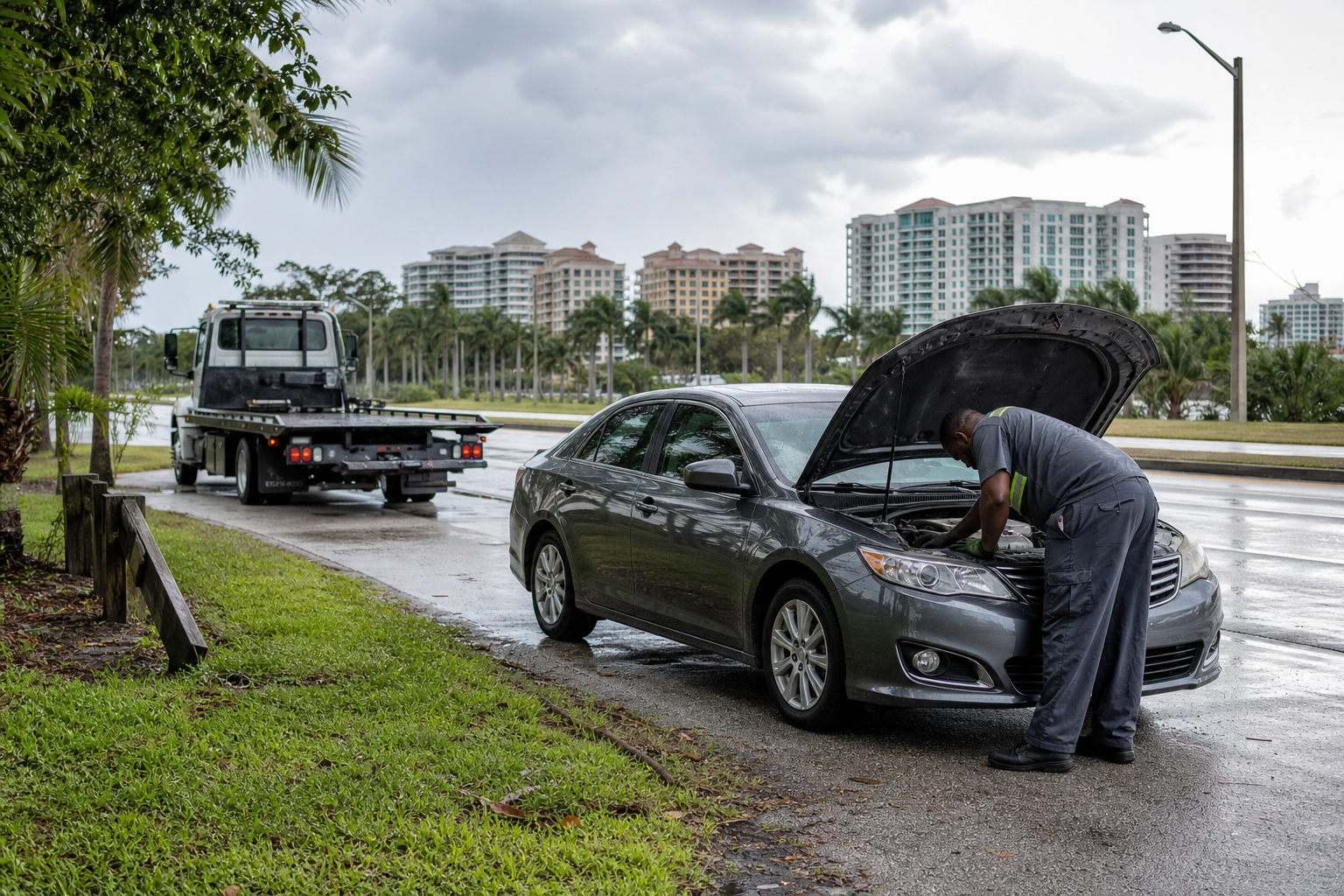
A sudden West Palm Beach downpour can hide the first sound of a failing serpentine belt. Tire spray and heavy rain may cover a squeal or slapping noise, while wipers, lights, and the ventilation fan add electrical demand just as a loose belt stops the alternator from charging properly. If the steering then becomes heavy or the temperature gauge begins climbing, the decision is no longer about reaching a nearby destination. It is about getting out of moving traffic without turning a belt failure into an overheated engine or a harder-to-control vehicle.
A serpentine belt can drive several accessories, depending on the vehicle: the alternator, water pump, power-steering pump, and air-conditioning compressor are common examples. Belt routing differs by model, so one car may lose steering assistance immediately while another retains it. That uncertainty is the reason combined warning signs should be treated as a stop signal rather than a test of how far the car can go.
The 60-second roadside response
- Ease off the accelerator. Avoid abrupt steering or braking while checking the instrument panel.
- Move only far enough to leave the active traffic path. Choose a firm, visible area rather than soft ground or standing water.
- Shut off the engine. Continuing to idle can still cause overheating if the belt-driven water pump has stopped.
- Turn on the hazard flashers. Do not open the hood until the vehicle is stationary and you can do so without standing near traffic.
- Do not restart for diagnosis. Record the warnings and symptoms, then contact roadside assistance for a tow decision.
Never reach into the belt area while the engine is running. A partially attached belt can move without warning. If the engine is hot, do not open the cooling-system cap or pour water onto hot components.
Stop, reposition, or continue: the actual decision checklist
STOP and shut down if any one of these appears
- The temperature gauge is rising, an overheating warning appears, or steam is visible.
- The steering suddenly requires much more effort, especially during low-speed turns.
- The battery or charging warning appears together with squealing, slapping, overheating, or steering changes.
- You hear repeated whipping, flapping, grinding, or rubber slapping from the engine compartment.
- You smell hot rubber or see belt strands, rubber debris, or a belt hanging loose.
- Several systems change at once, such as loss of air conditioning followed by a charging warning.
These combinations suggest that the belt is no longer turning one or more accessories correctly. The engine may keep running on stored battery power, but that does not make continued driving safe. If the water pump depends on the belt, coolant circulation may also have stopped.
REPOSITION only if remaining where you are creates the greater danger
If the car stops in an active lane or another exposed position, a very short, controlled move to a nearby safe area may be necessary. Attempt that move only if the engine is not steaming, the vehicle still responds predictably, and the safer area is immediately reachable. Use smooth steering and steady brake pressure.
Do not interpret “reposition” as permission to drive to a repair shop, home, or the next convenient parking area. The goal is simply to clear traffic. Once clear, shut the engine off.
CONTINUE cautiously only when belt failure is not otherwise indicated
A single brief chirp during startup or immediately after rain, with normal steering, normal temperature, no warning lights, no odor, and no recurring noise, does not by itself prove the belt has broken. You may proceed to a safe destination while watching the gauges and listening for recurrence. If the sound returns or any second symptom appears, change the decision to STOP.
Why “just a few more minutes” can multiply the damage
Cooling may stop. On vehicles with a belt-driven water pump, a broken belt can halt coolant circulation. South Florida heat leaves less margin for sitting in traffic or idling without effective cooling. Once the temperature starts climbing, there is no dependable safe distance.
The battery is not a backup engine supply. If the alternator is no longer turning, the battery carries the electrical load temporarily. Wipers, lights, fans, and other systems can consume that reserve. The engine may stall, and it may not restart after shutdown.
Steering effort may rise sharply. A vehicle with belt-driven hydraulic power steering can become much harder to turn. Electric power steering may behave differently, which is why the vehicle’s response—not an assumption about its equipment—should guide the stop decision.
Braking can feel different after an engine stall. The brakes do not automatically disappear when a belt breaks, but power assistance may become limited if the engine stops. The pedal can require firmer pressure. Avoid pumping the pedal unnecessarily; use steady pressure while bringing the vehicle to a controlled stop.
Loose belt material can affect nearby parts. A shredding belt may wrap around pulleys, damage wiring, or disturb hoses and seals. Restarting the engine to “see if it clears” can make that secondary damage worse.
Choose a stopping place that a service vehicle can actually reach
Rain changes more than visibility in Palm Beach County. Water can disguise a soft shoulder, collect around the passenger side, or place you where passing vehicles throw heavy spray. If the car still responds and a safe paved area is directly available, prefer that over standing water or unstable ground. Do not drive through deeper water merely to find a more convenient waiting spot.
Once stopped, note the vehicle’s exact position and any access issue. Tell the dispatcher if the car is inside a parking structure, behind a gate, in a narrow space, nose-in against a curb, or unable to shift normally. Mention low overhead clearance or restricted turning room. Those details help determine what equipment can approach the car and whether it must be moved before loading.
If you are fully outside traffic and can exit safely on the side away from passing vehicles, wait in a protected location. In hot weather, an engine-off cabin can become uncomfortable quickly, so account for children, older adults, pets, and anyone with a health concern when describing the situation. If getting out would expose you to moving traffic, remaining buckled may be safer until help arrives.
Give roadside assistance a symptom-based handoff
A clear handoff prevents a belt failure from being mistaken for a simple dead battery. Provide:
- The vehicle year, make, model, and fuel type.
- Which warning appeared first: battery, temperature, or another alert.
- Whether steering effort changed.
- Any squealing, slapping, grinding, steam, or hot-rubber odor.
- Whether the engine is off and whether it restarted after the symptoms began.
- Any visible loose belt or rubber debris—observed only with the engine off.
- Your exact position and the access conditions around the vehicle.
On-site assistance may confirm that towing is the safer next step, but a serpentine-belt replacement is not always a practical roadside repair. The correct belt must be available, its routing must be verified, and the cause of failure must be checked. A seized pulley, damaged tensioner, leaking fluid, or overheated engine cannot be solved by installing a belt alone.
Make the call from the symptom, not the remaining distance
If you have a rising temperature, heavy steering, multiple warning lights, steam, a hot-rubber smell, or a visible damaged belt, leave the engine off and arrange roadside help and towing evaluation. If there was only one brief noise and every system remains normal, proceed cautiously while monitoring the car and schedule an inspection. Any recurring noise or added warning moves the decision back to STOP.
Broken serpentine belt FAQs
Can I drive a short distance with a broken serpentine belt?
Do not continue normal driving. Move only as far as necessary to escape an active traffic hazard. A short distance can still be enough to overheat an engine or exhaust the battery if the belt drives the water pump or alternator.
Does the battery light always mean the battery failed?
No. The light usually indicates a charging-system problem. If it appears with belt noise, overheating, heavy steering, or lost air conditioning, a slipping or broken belt may have stopped the alternator from turning.
Can roadside assistance replace the belt where the car stopped?
Sometimes a belt issue can be assessed roadside, but replacement depends on parts availability, access, belt routing, and whether another component caused the failure. Towing is the safer handoff when overheating, pulley damage, fluid leaks, or a shredded belt are involved.
Why did the air conditioning stop before the other warnings appeared?
The belt may drive the air-conditioning compressor, or a vehicle may reduce accessory loads as a problem develops. Air-conditioning loss alone has several possible causes, but it becomes a strong belt warning when paired with charging, temperature, steering, noise, or odor symptoms.