The highest-risk mistake is trying to drag, push, or tow a damaged vehicle before anyone knows which wheels can roll and which end is damaged. A vehicle may move a few feet and still suffer worse bumper, suspension, transmission, wheel, or underbody damage. The safer choice is to stop, make the scene visible, and report what you can see so roadside assistance can send equipment suited to the vehicle's condition.
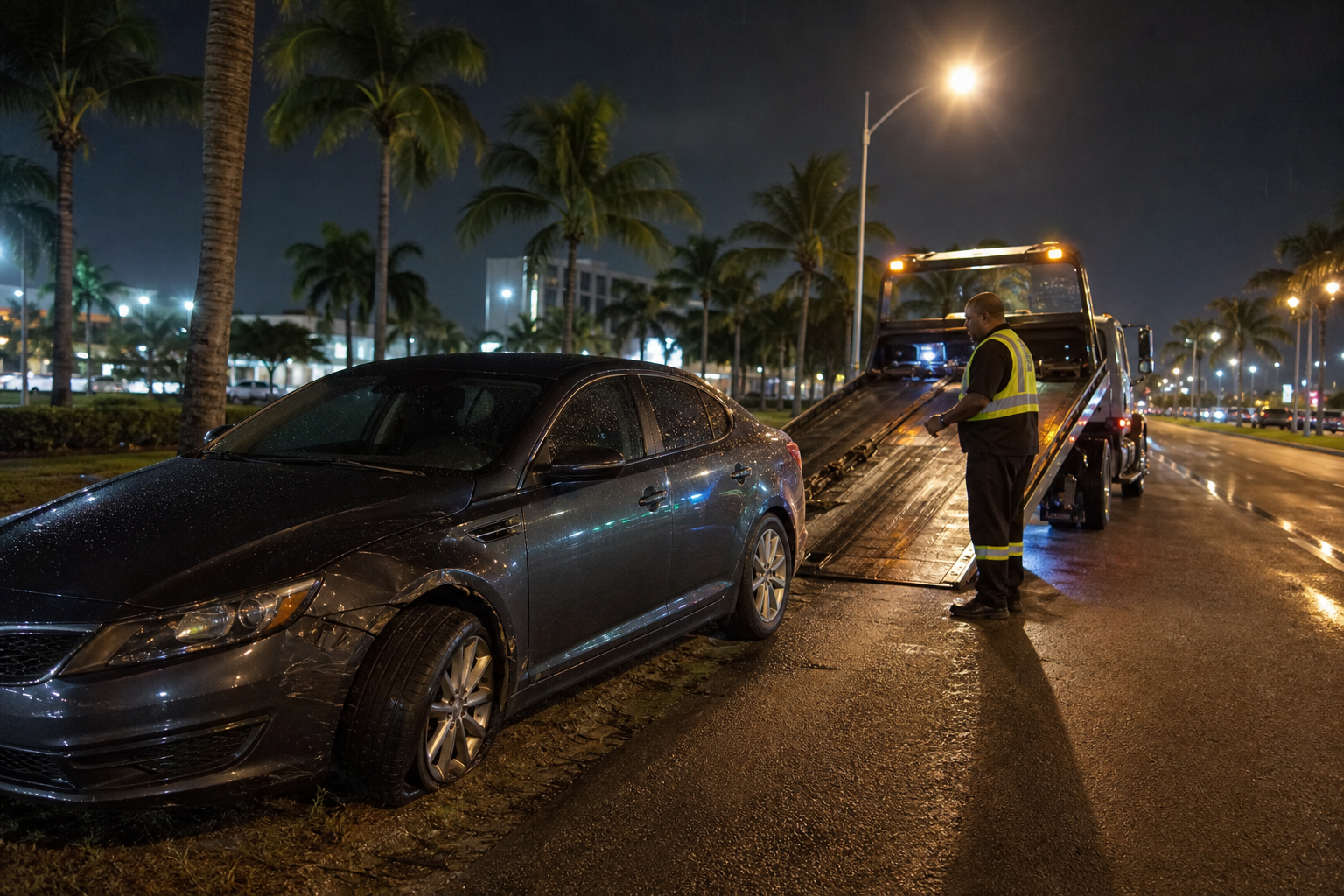
In West Palm Beach, a nighttime breakdown can add low visibility, rain-slick pavement, standing water, and fast-moving traffic to an already stressful situation. You do not need to diagnose the vehicle. Your job is to protect yourself, avoid making the damage worse, and give a tow operator a usable picture of what happened.
The first 10 minutes: protect the person before the vehicle
- Get out of the active travel path if the vehicle can move normally and safely. If it is already stopped in a safer position, do not attempt to reposition it simply to make towing easier.
- Turn on hazard flashers. At night or during rain, use available interior or exterior lighting only if it helps others see the vehicle without creating a distraction.
- Choose your waiting position. If you can safely exit, stand away from traffic and away from the vehicle's likely loading path. Do not stand between the disabled vehicle and the approaching tow truck.
- Look for immediate no-move signs. A hanging bumper, fluid leaking heavily, a wheel pointing at an unusual angle, a tire folded under the vehicle, scraping underneath, smoke, or a vehicle that will not roll normally means it should not be pushed or pulled casually.
- Arrange help before touching the parking brake, steering wheel, or shifter again. Once assistance is on the way, follow the operator's instructions about securing the vehicle. A parking brake, electronic shifter, damaged wheel, or drivetrain fault can change how the vehicle must be loaded.
Quick handoff: Tell the dispatcher: vehicle type, where it is stopped, whether it rolls, which end is damaged, whether a wheel or tire is affected, and whether it is safe for you to wait nearby. For a lockout without collision or mechanical damage, use car lockout service instead of requesting a tow.
Decision points that determine the towing method
A tow operator is not choosing equipment based on appearance alone. Clearance, drivetrain, wheel condition, and damage location determine how the vehicle can be lifted, rolled, winched, and secured without adding avoidable harm.
1. Can all four wheels roll?
This is the first practical question. A wheel-lift raises one end of a vehicle while the other end rolls on the road. That can be appropriate for some vehicles with intact rolling wheels and no drivetrain restrictions. It is not a simple answer of “front first” or “rear first,” because the vehicle's drivetrain and damage decide which wheels may remain on the ground.
If one or more wheels are locked, bent, flat enough to come off the rim, pointed sideways, missing, or blocked by collision damage, the vehicle may need dollies. Dollies are small wheeled platforms placed under tires that cannot safely roll. They let the operator move a disabled vehicle while keeping a damaged or non-rolling wheel from dragging across pavement.
If the vehicle cannot be moved without forcing a wheel, dragging a suspension component, or scraping the underside, a flatbed is commonly the safer direction. The vehicle is loaded so all four wheels are carried off the ground rather than rolling behind the truck.
2. Which wheels receive engine power?
Drivetrain matters because rotating the wrong wheels can move parts of the driveline when the vehicle is disabled, in park, or unable to be placed in the required towing mode. A front-wheel-drive, rear-wheel-drive, all-wheel-drive, and four-wheel-drive vehicle may each have different limits on which wheels can remain on the road during transport.
For a driver, the useful point is simple: do not assume neutral makes every vehicle safe to tow with two wheels down. All-wheel-drive and four-wheel-drive systems are especially likely to require all wheels off the ground or a method that prevents the road wheels from turning. The operator can confirm the correct procedure using the vehicle information and its condition at the scene.
3. Is the vehicle low, lowered, or damaged at the front or rear?
Clearance changes the loading plan. A low front bumper, split lower valance, damaged exhaust, hanging splash shield, or lowered suspension can catch on standard loading ramps. A steep loading angle can also make the front or rear of the vehicle scrape before its tires reach the deck.
To reduce that risk, an operator may adjust the flatbed angle, use ramp extensions or loading aids, change the approach position, or winch the vehicle carefully rather than driving it onto the bed. Winching means pulling the vehicle onto the carrier using controlled cable force. It is useful when the vehicle will not start, cannot be driven, or needs to be loaded without putting extra force through damaged wheels. The winch attachment point matters; pulling from a bumper, suspension arm, or visibly damaged component can cause further damage.
4. Is the damage cosmetic, or does it affect movement?
A scuffed door or cracked mirror may not change the towing method. Damage affecting steering, wheels, suspension, axles, underbody panels, drivetrain components, or the vehicle's ability to roll is different. A bumper that looks minor can still hide a loose panel that will drag during loading. A vehicle that starts normally may still be unsafe to drive onto a carrier if a wheel is rubbing, the steering is off-center, or fluid is leaking.
A useful dividing line: if the vehicle can move a few feet without unusual noise, pulling, scraping, warning signs, or resistance, it may be capable of careful repositioning only when necessary for immediate safety. If movement feels abnormal or damage is visible around a wheel or under the vehicle, leave it in place unless remaining there creates a direct roadway danger. Tell the dispatcher that the vehicle may be unsafe to reposition.
What to report so the right truck arrives
One concise report is better than repeated guesses. Use this checklist:
- Your location in West Palm Beach and which direction the vehicle faces, if known.
- Whether you are in a travel lane, shoulder, parking area, driveway, or another safer off-road position.
- Vehicle year, make, model, and whether it is front-wheel drive, rear-wheel drive, all-wheel drive, or four-wheel drive if you know it.
- Whether the vehicle starts, shifts, steers, and rolls normally.
- The damaged area: front, rear, driver side, passenger side, underbody, or a specific wheel.
- Any wheel that is flat, bent, turned sideways, locked, or rubbing.
- Low-clearance features, lowered suspension, or parts hanging underneath.
- Any visible fluid, smoke, or strong burning odor.
- Nighttime visibility concerns, rain, standing water, or a place where you do not feel safe waiting.
Photos can help if taking them does not place you near traffic. A wide photo showing the vehicle's position and a closer photo of the damaged area can be useful to the dispatcher or operator. Do not crawl under the vehicle or reach behind a wheel to get a better image.
What roadside help does next
After receiving your report, the provider can determine whether you need a lockout technician, basic roadside assistance, a wheel-lift setup, a flatbed, dollies, or a loading plan that includes controlled winching. At the scene, the operator will assess clearance, wheel movement, access to safe attachment points, drivetrain requirements, and the available space to load without placing you in danger.
The operator may ask you to provide the key, unlock the steering wheel, locate a tow point, or move personal belongings out of the vehicle. Do not enter the vehicle or release any brake unless directed. Loading creates a changing work area: ramps move, cables tighten, and the vehicle's position can shift.
If the issue is a lockout and the vehicle is otherwise undamaged, a technician may be able to restore access without towing. If the vehicle is stranded because of a non-collision roadside problem, roadside assistance can help determine whether service at the location is appropriate or whether transport is the safer next step.
Questions drivers often ask
Can a vehicle with a flat tire be towed?
Sometimes, but the answer depends on whether the tire still supports the wheel, whether the wheel is damaged, and which wheels must remain off the ground for that drivetrain. A severely flat tire, bent wheel, or damaged suspension may call for dollies or a flatbed.
Why can't every vehicle be towed with a wheel-lift?
A wheel-lift leaves two wheels rolling on the road. That may be unsuitable when those wheels are connected to the drivetrain, cannot rotate freely, are damaged, or would cause the vehicle to scrape. It also may not be suitable for low-clearance or collision-damaged vehicles.
Does a flatbed prevent all damage?
A flatbed keeps all wheels off the road during transport, which can reduce drivetrain and rolling-wheel concerns. Loading still requires care. Low bumpers, loose panels, wheel damage, and poor loading angles must be managed correctly.
Should I drive the vehicle onto the tow truck if it still starts?
Only if the operator directs you to do so. Starting does not confirm that the steering, wheel alignment, suspension, drivetrain, or underbody is safe for driving up ramps.
A calm next step
If your vehicle is stuck, damaged, low to the ground, or unsafe to move in West Palm Beach, report the wheel condition, drivetrain if known, and visible damage when you request assistance. That information helps send towing equipment that can carry the vehicle rather than forcing it to roll, scrape, or be pulled from the wrong point.