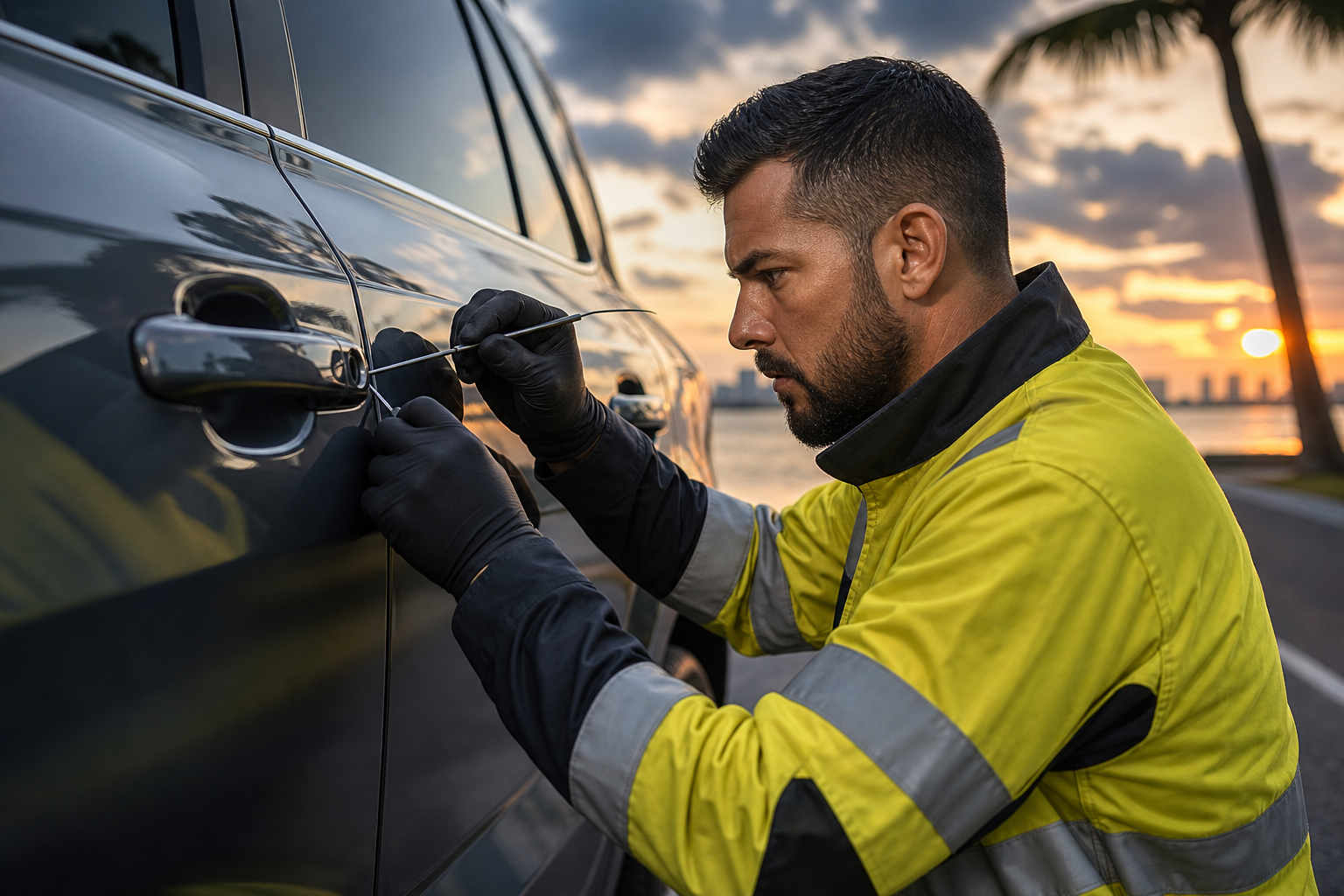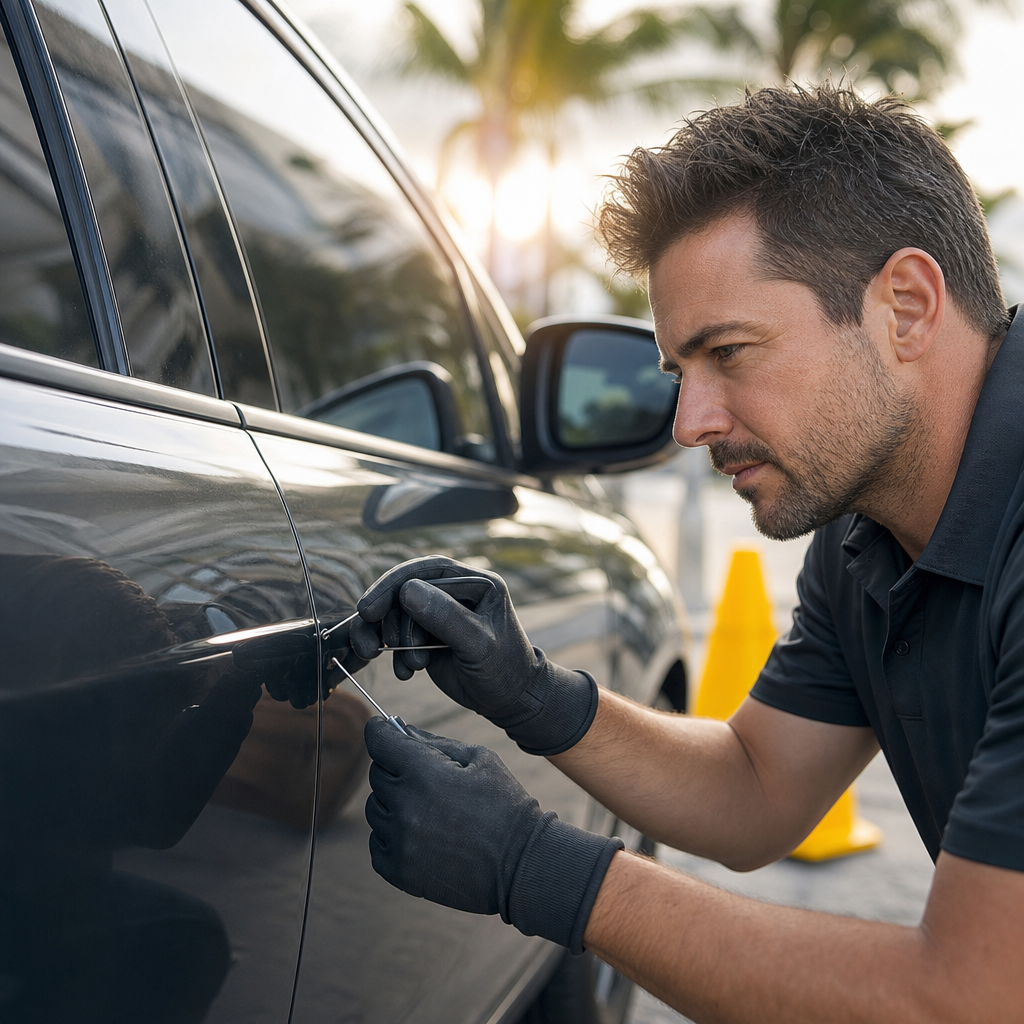
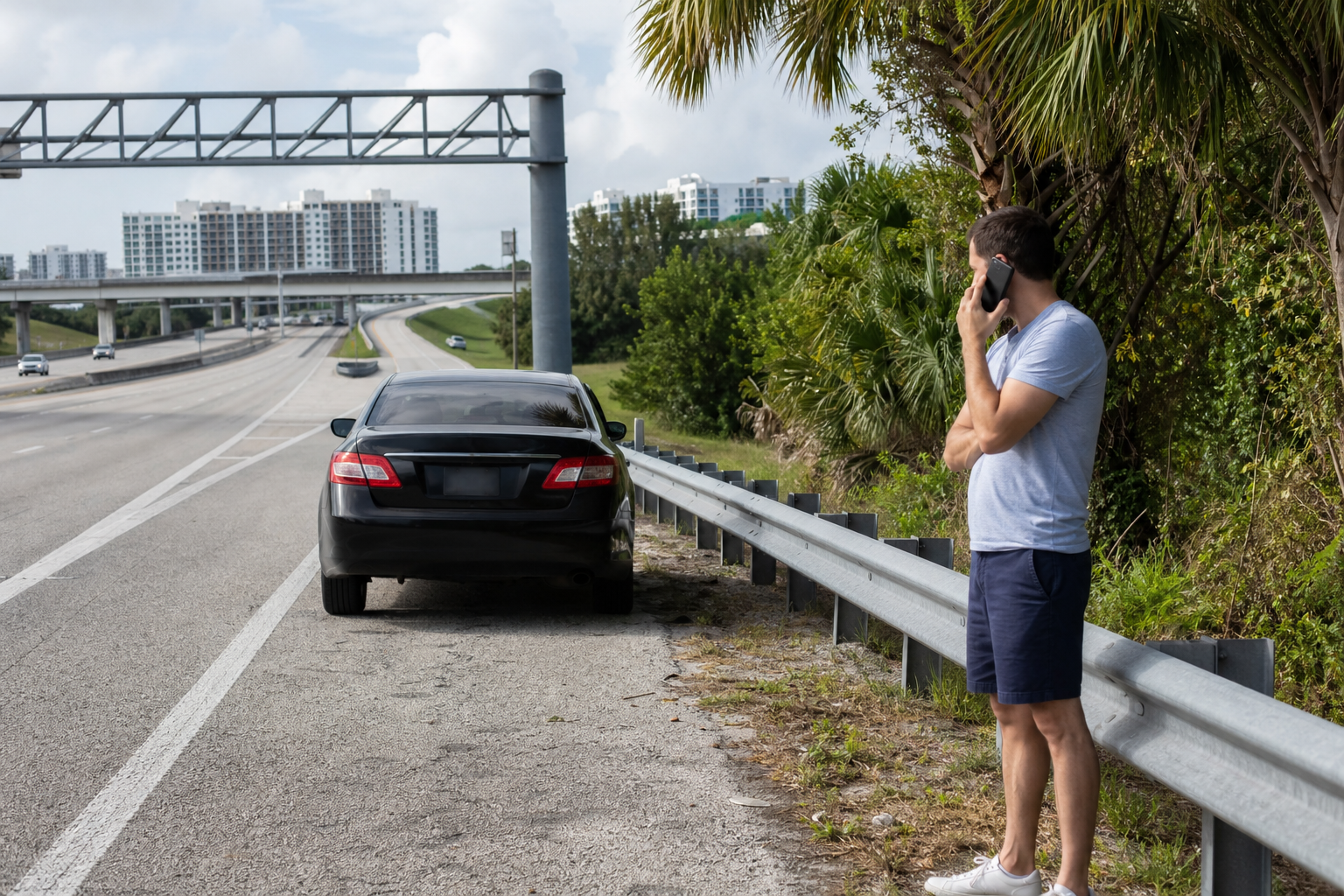
Use this rule first: if you can state the highway name, your direction of travel, and whether the vehicle is on the shoulder, an exit ramp, or an entrance ramp, call roadside assistance now. Do not spend extra time searching for a perfect pin if your location is exposed or traffic is close.
A lockout on a highway is different from a lockout in a driveway or parking lot. The dispatcher needs enough information to send help to the right roadway segment and the right side of the interchange. In West Palm Beach and Palm Beach County, highway approaches can place several roads, ramps, overpasses, and parallel lanes close together. A nearby sign or visible roadway may describe a road above, below, or beside you—not necessarily the pavement where your car is stopped.
Situation matrix: identify the location detail that matters most
| What you can see or confirm | Tell the dispatcher | What not to assume |
|---|---|---|
| A highway shield or route name | “I am on [route name], traveling north/south/east/west.” | Do not report only the city or county. A route can pass through multiple access points and interchange levels. |
| An exit number or exit destination sign | “I am before/after Exit [number], on the [main highway / exit ramp / entrance ramp].” | Do not say “at the exit” if you are actually on the through lanes, a ramp loop, or an approach road. |
| A green mile marker or roadside reference marker | Give the complete number exactly as shown, plus your direction of travel. | Do not rely on a partial number or a marker seen across the median. |
| An interchange with several elevated or curved ramps | Describe your position: “on the ramp leaving the highway,” “on the ramp joining the highway,” or “on the highway passing the interchange.” | Do not use the name of the road visible overhead unless you know your vehicle is on that road. |
| A map pin from your phone | Read the route label nearest the pin, then compare it with a physical sign, your last exit, or your travel direction. | Do not treat the map’s direction arrow as proof while stationary. GPS heading can drift when the phone is not navigating. |
| No signs, no marker, and poor visibility | Give your last confirmed exit, the direction you had been traveling, and how long you have been stopped. | Do not leave a safer position to hunt for a sign or walk along the roadway. |
Stop or continue: make the safety decision before the location call
Stop and call for help immediately if the vehicle is on a shoulder, ramp, bridge approach, narrow edge, or other place where you cannot safely walk to obtain a better reference. Call emergency services first if you or anyone nearby faces immediate danger, then provide the same roadway details to roadside assistance.
Do not intentionally move into or remain in a gore area—the painted triangular split between through lanes and a ramp. It is an exposed traffic area, not a waiting area and not a useful landmark to seek out. If the vehicle is already near one, tell the dispatcher that fact so the service provider understands the position.
Continue only when the vehicle is drivable, you are inside it, and you can safely reach a clearly safer location without improvising. This may apply to a driver who still has access to the car but needs roadside assistance. It does not apply to a typical lockout where you are outside and the keys are inside. If you are locked out, do not try to reposition the vehicle, activate controls you cannot reach, or force entry to make the location easier to explain.
If traffic conditions allow you to stand well away from moving vehicles, move to a safer waiting position without crossing active lanes. Keep the vehicle in view when practical, but do not place yourself between the car and traffic. A service vehicle can work from your vehicle location; it does not require you to stand beside the door.
Roadside location checklist: build one sentence a dispatcher can use
Before calling, collect the strongest clues you already have. A useful report is not a long story. It is a sequence that narrows the search area.
- Route: State the highway or road label shown on the most recent sign or confirmed in your map.
- Direction: State the direction you were traveling before stopping. Verify it using route labels, signage, your last known travel direction, or navigation instructions—not only the phone’s arrow.
- Road position: Say “right shoulder,” “left shoulder,” “entrance ramp,” “exit ramp,” “ramp loop,” or “main lanes.”
- Interchange relationship: Say “before the exit,” “after the exit,” “leaving the highway,” or “joining the highway.”
- Fixed clue: Give an exit number, marker, overpass, or the last confirmed exit. If you see an overpass, explain whether you are under it, over it, or approaching it.
- Vehicle description: Provide color, make, model, plate if available, and the safest visible feature such as a rear hatch, roof rack, or body style.
- Access issue: State plainly: “I am locked out and outside the vehicle,” or “I am inside the vehicle but cannot access the keys.”
Use this call-ready format: “I am on [route], traveling [direction], on the [shoulder/ramp/main lanes], [before/after/leaving/joining] Exit [number or landmark]. The vehicle is a [color, make, model], and I am locked out [outside/inside].”
If the dispatcher repeats a location that does not sound right, correct one item at a time: route first, then direction, then ramp versus main highway. This is especially useful around West Palm Beach and Palm Beach County interchange areas, where a provider may need to approach from a specific roadway side or ramp access point rather than the nearest visible street.
Service preparation: make the lockout handoff faster and safer
- Keep your phone charged if possible and answer unfamiliar calls after requesting service; the provider may need to confirm the access point.
- Share the best available map pin after giving the verbal route and ramp details. A pin supports the description; it should not replace it.
- Send an updated pin only if you have moved to a safe waiting place and can explain that the vehicle remains at the original location.
- Have identification and proof of authorization available if they are accessible without entering the vehicle. Do not search for documents in traffic areas.
- Tell dispatch about any access constraint: locked doors, keys visible inside, child or pet inside, a blocked driver door, or a vehicle positioned close to a barrier.
- Do not promise that the provider can approach from a particular side unless dispatch confirms it. Highway barriers, ramps, and restricted access can change the safest approach.
For help with a locked vehicle, use Car Lockout Service and be ready to read the call-ready format above. If the issue involves a broader roadside problem, Roadside Assistance can help you start with the same location details. Drivers who are safely off the highway but still cannot access their vehicle can also review locked out of my car guidance before calling.
Quick answers for highway lockouts
What if I only know that I am in West Palm Beach?
Say West Palm Beach and Palm Beach County, then add the last route, exit, direction, or ramp detail you remember. “West Palm Beach” alone is not enough to identify a highway position.
Should I walk to the next exit sign?
No. Use the information you already have if walking would place you near moving traffic, ramps, shoulders, or barriers. Tell dispatch your last confirmed exit and your road position instead.
My map pin appears between two roads. What should I report?
Report the route and road position you can verify independently. Explain that the map pin may be near an overpass or interchange. Give the last sign you saw and whether you were entering, leaving, or continuing on the highway.
What if I am locked out on an exit ramp?
Say that you are on the exit ramp, identify the highway you exited, provide the travel direction before you took the ramp, and state whether you are near the ramp start, curve, or end. Do not describe yourself as being “on the exit” without naming the highway.
What should I do after I place the service call?
Keep your phone available, remain in the safest practical waiting position, and be ready to repeat your route, direction, ramp or shoulder position, and vehicle description. If your situation becomes immediately dangerous, call emergency services first.