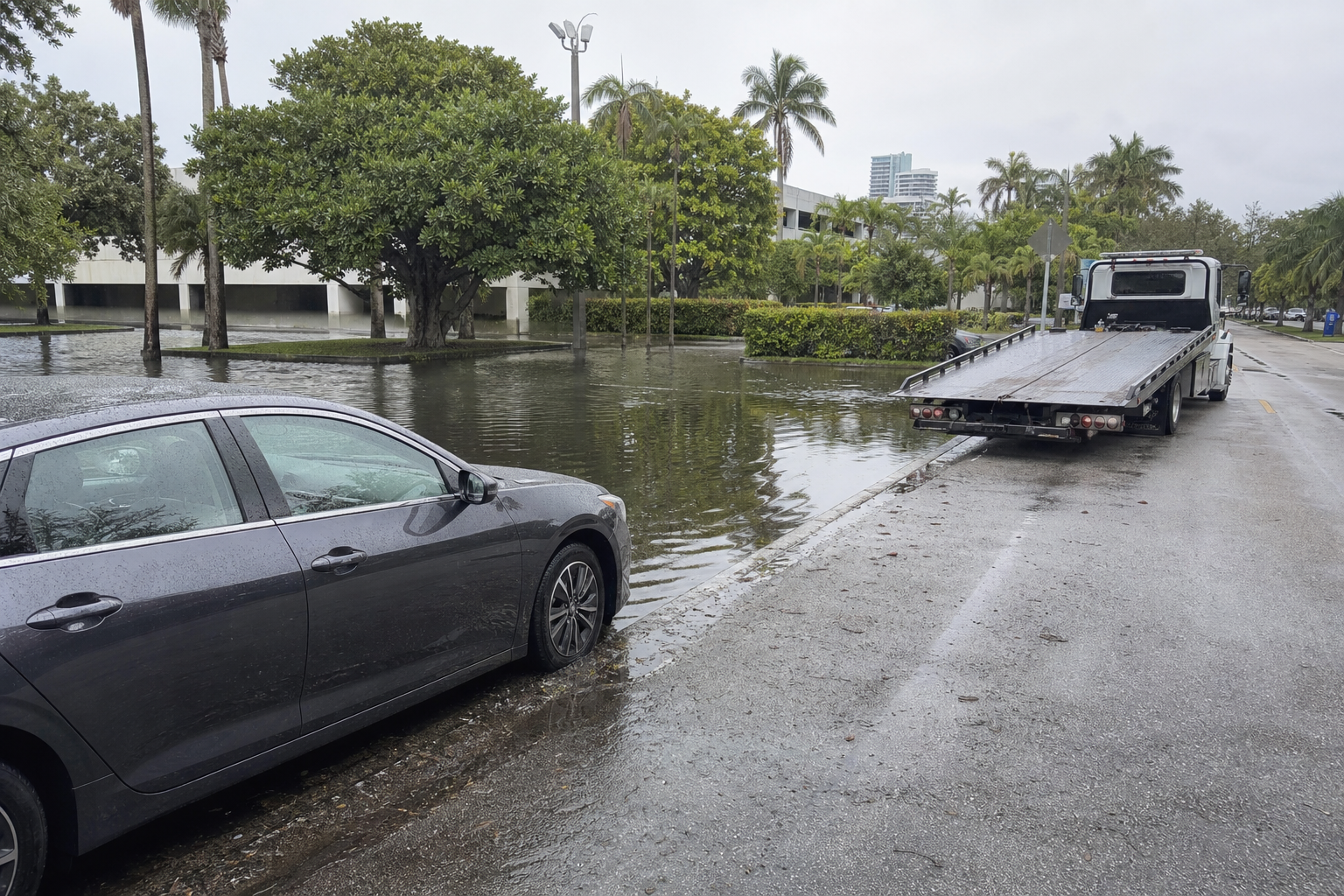
Use this decision rule: If the engine stalled in water, floodwater entered the cabin, or water may have reached the air intake or high-voltage components, leave the ignition off and arrange a tow. Restarting is not a safe way to test the vehicle.
The scenario: the water drops, but the risk remains
Your vehicle is parked or stopped in West Palm Beach after floodwater moved through the area. The water may already be receding. The exterior looks intact, and the dashboard might still illuminate. That can make a quick restart seem reasonable.
The condition you cannot see is what determines the next step. Water may be inside the engine’s air path, electrical connectors, control modules, cabin wiring, wheel components, or fluids. On an electric or hybrid vehicle, flood exposure may also involve high-voltage equipment. Turning the key or pressing the start button can energize wet circuits or cause the engine to pull in water.
A stalled vehicle is the clearest warning. If the engine stopped while surrounded by water, do not attempt another start—even if the water was present only briefly.
Do this before checking the vehicle
Immediate-action card
- Keep the ignition off. Do not press the start button, use remote start, or switch into an accessory mode just to check the dashboard.
- Move yourself to a protected location. Stay away from moving traffic, standing or flowing water, downed wires, smoke, unusual heat, hissing, or bubbling. Do not wade back to the vehicle.
- Use emergency help for an active hazard. Rising water, a trapped occupant, fire, or electrical danger requires emergency services rather than an ordinary roadside response.
- Call from where you can remain reachable by phone. You do not need to stand beside the vehicle or expose yourself to make it easier to see.
If conditions are stable and you can observe the car from dry ground, note the highest visible water line. Photos taken from a safe position can help document the condition, but do not open doors or touch the vehicle while it remains in water.
What a restart can change
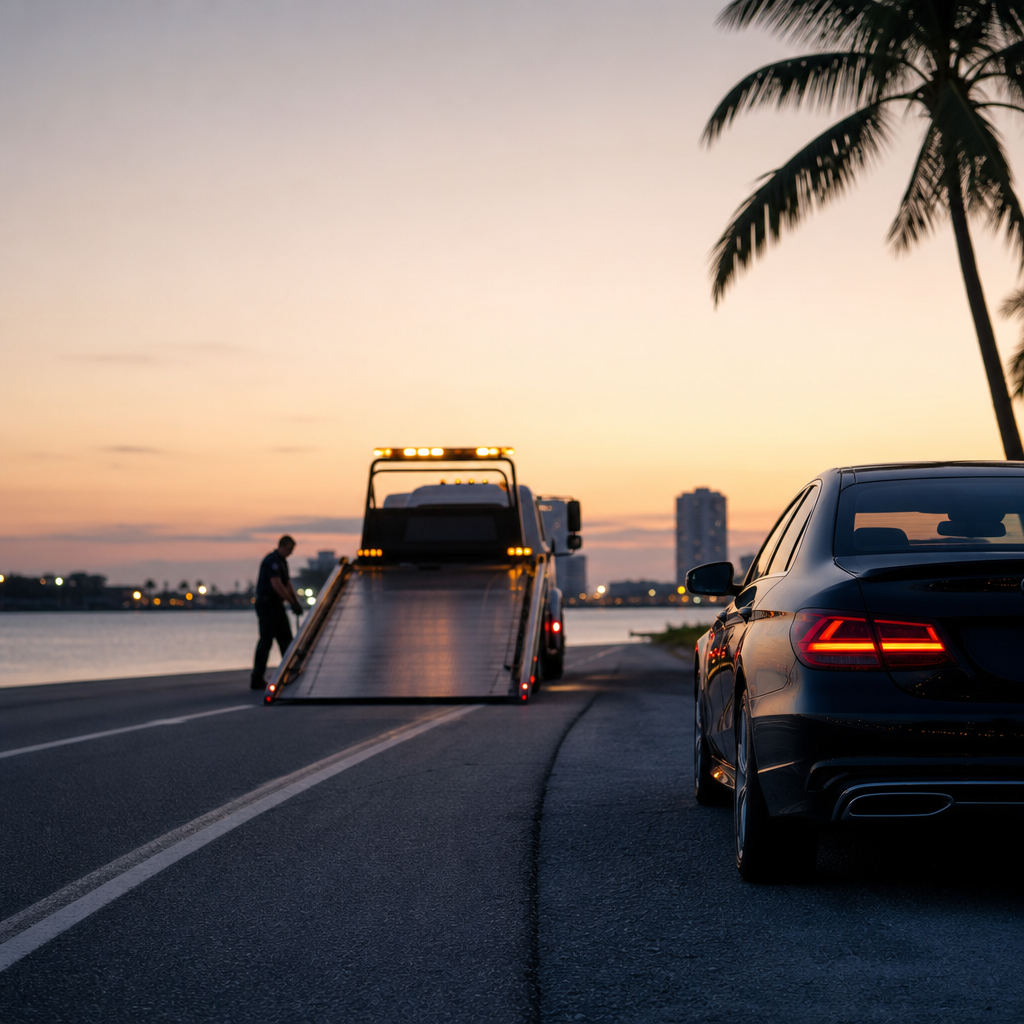
A tow request after flood exposure is not simply about moving a car that will not run. It is a way to avoid adding mechanical or electrical damage before the vehicle can be evaluated.
- Engine risk: Water entering an engine cylinder cannot compress like air. A restart attempt can damage internal engine parts.
- Electrical risk: Powering wet connectors and modules may create short circuits or cause failures that were not present while the vehicle remained off.
- Contamination risk: Floodwater may enter fluids, bearings, interior components, or ventilation passages without leaving an obvious exterior clue.
- Delayed symptoms: A vehicle may start and move before warning lights, braking concerns, shifting problems, or electrical faults appear.
Roadside personnel can help coordinate access and transport, but a parking-lot start test cannot establish that a flood-exposed vehicle is safe to drive.
Tow or drive: decide from the vehicle’s condition
| Condition observed | Safer default |
|---|---|
| The engine stalled while the vehicle was in water | Do not restart; request towing |
| Water entered the passenger cabin | Leave electrical systems off; request towing |
| The water depth or highest water line is unknown | Do not use driving as a test; request towing |
| Warning lights, rough operation, unusual sounds, or electrical problems appeared after exposure | Shut the vehicle off in a safe place and request towing |
| Water touched only the lower tires, the vehicle never stalled, and no water reached the cabin or underbody components | Do not assume it is safe; describe the exposure when requesting guidance |
If you cannot confidently place the vehicle in the final category, choose the tow option. Uncertainty about depth, duration, or vehicle condition is itself a reason not to restart.
Electric and hybrid vehicles need clear identification
Tell dispatch whether the vehicle is fully electric, a plug-in hybrid, or a conventional hybrid. High-voltage battery equipment may be positioned low in the chassis, and the correct recovery method can depend on the model and its condition.
Do not touch exposed orange cables, attempt to disconnect a high-voltage battery, or approach a vehicle showing smoke, heat, popping, hissing, or bubbling. Move farther away and contact emergency services if those signs appear. Even a vehicle that looks powered down may still contain energized high-voltage components.
West Palm Beach access details that affect the handoff
For a response in West Palm Beach, state both the city and Palm Beach County when speaking with dispatch. Send a location pin, then confirm it with a street address, property entrance, nearby cross street, or other verifiable access detail shown on your map. A pin alone may identify the car without showing the best route for a tow truck.
Describe what lies between the truck and the vehicle:
- Standing or moving water
- A gate, parking structure, narrow entrance, or low-clearance area
- Soft ground, debris, curbs, or blocked access
- The vehicle’s direction of travel and whether wheels are turned
- Whether the vehicle is in Park, in gear, or unable to shift
Do not ask an operator to enter water you would not safely enter yourself. Recovery may need to wait until the approach is stable and accessible. Roadside assistance dispatch can use your description to determine whether a standard tow approach is suitable or whether additional recovery planning is needed.
Prepare a clean service handoff
Give dispatch a short, condition-based report rather than saying only that the car “got wet.” Include:
- Vehicle year, make, model, and color
- Gasoline, diesel, hybrid, plug-in hybrid, or full-electric powertrain
- Whether the engine stalled, was shut off normally, or was never started
- Approximate highest water line and whether water entered the cabin
- Any smoke, odor, heat, warning message, leaking fluid, or unusual sound
- Exact West Palm Beach pickup point and access obstacles
- Key location and whether the steering or transmission can be released
- Your intended towing destination, if already selected
The operator should choose loading points and towing configuration based on the vehicle and manufacturer requirements. Avoid attaching your own straps or trying to push a flood-exposed vehicle through standing water.
If the car locked automatically after you moved away, do not return through water for the keys. Tell dispatch they are inside. Once the area and vehicle are safely accessible, a car lockout service may be coordinated as part of the handoff.
Before you place the call
- Ignition remains off
- Everyone is away from traffic and floodwater
- Powertrain type is identified
- Stall status and visible water line are known
- Location pin and access description are ready
- Keys are accounted for
- Smoke, heat, hissing, or electrical hazards have been reported
Flood-exposed vehicle FAQs
Can I restart the engine after the water recedes?
Not if the engine stalled, the water depth is uncertain, or water may have reached the intake, cabin, or electrical equipment. Receding water does not remove water already inside the vehicle.
What if the dashboard lights work normally?
Normal lights do not confirm that the engine, wiring, braking system, or fluids are unaffected. Avoid using accessory mode or repeated start attempts as a diagnosis.
Should I disconnect the battery?
Do not reach into standing water or handle battery connections on a flood-exposed vehicle. Never attempt to disconnect high-voltage equipment on an electric or hybrid vehicle. Report the condition and powertrain type to dispatch.
Can roadside assistance repair flood damage where the car sits?
Roadside service is best used to assess access, manage a lockout if needed, and coordinate safe transport. Internal flood damage generally requires evaluation in an appropriate facility rather than roadside testing.
When is towing the clear choice?
Request a tow if the vehicle stalled in water, the cabin became wet, the depth is unknown, electrical symptoms appeared, or an electric or hybrid vehicle may have had battery-area exposure. Remain in a protected location away from traffic and water while staying reachable by phone.
Make the call based on uncertainty, not appearance
If you know the vehicle stalled or took on water, ask for towing and keep it off. If you cannot verify the water depth or affected components, make the same choice. A dry exterior after the water falls is not proof that the vehicle is ready to drive.