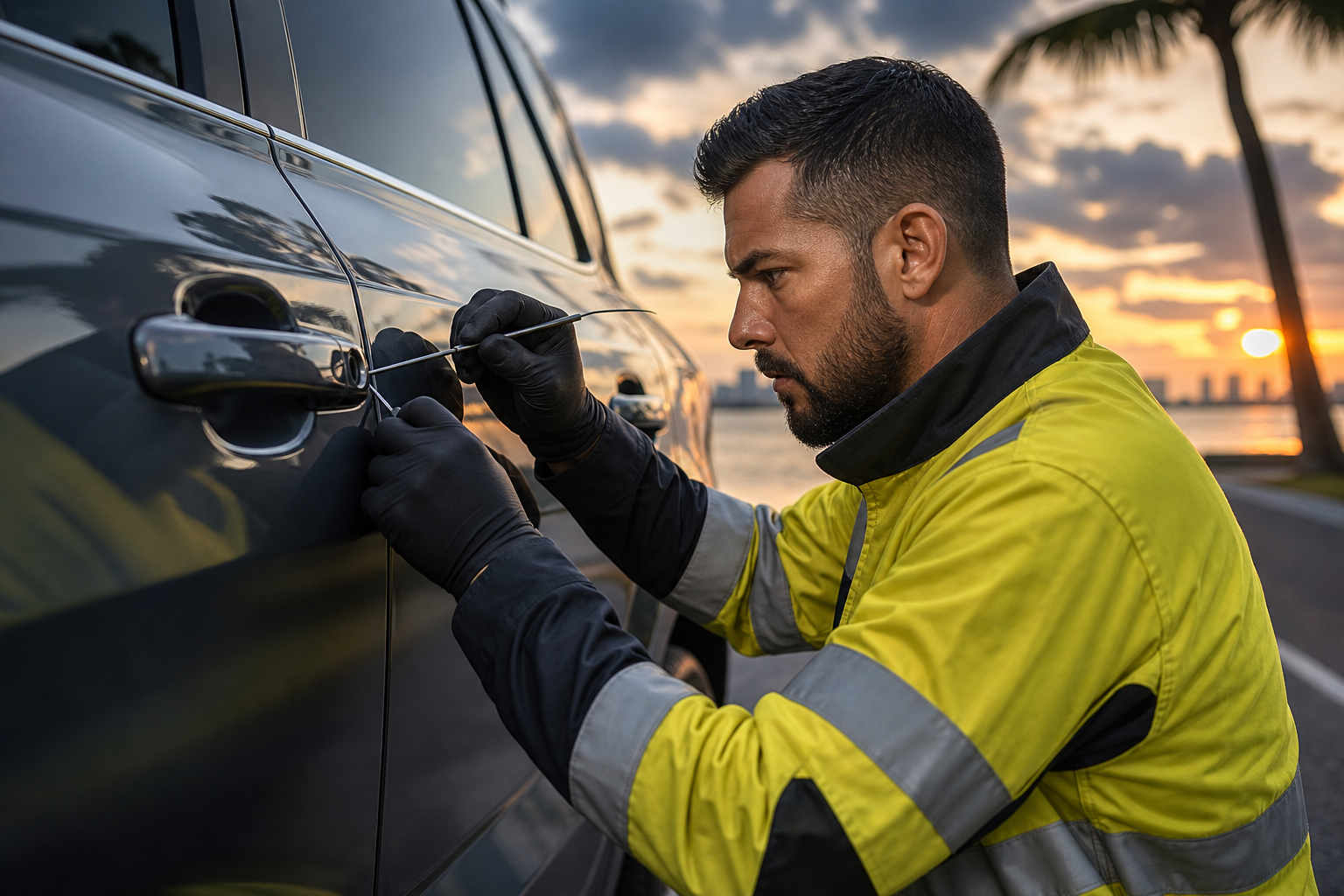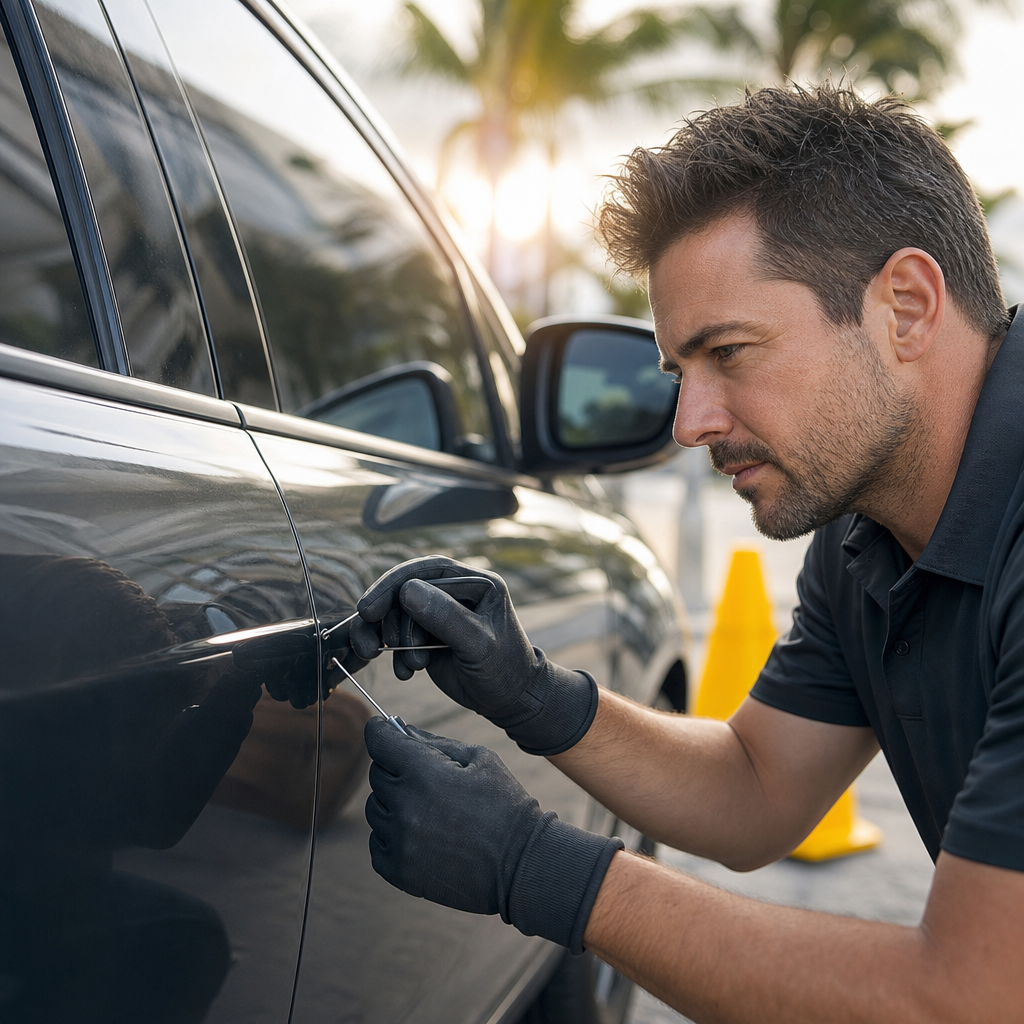
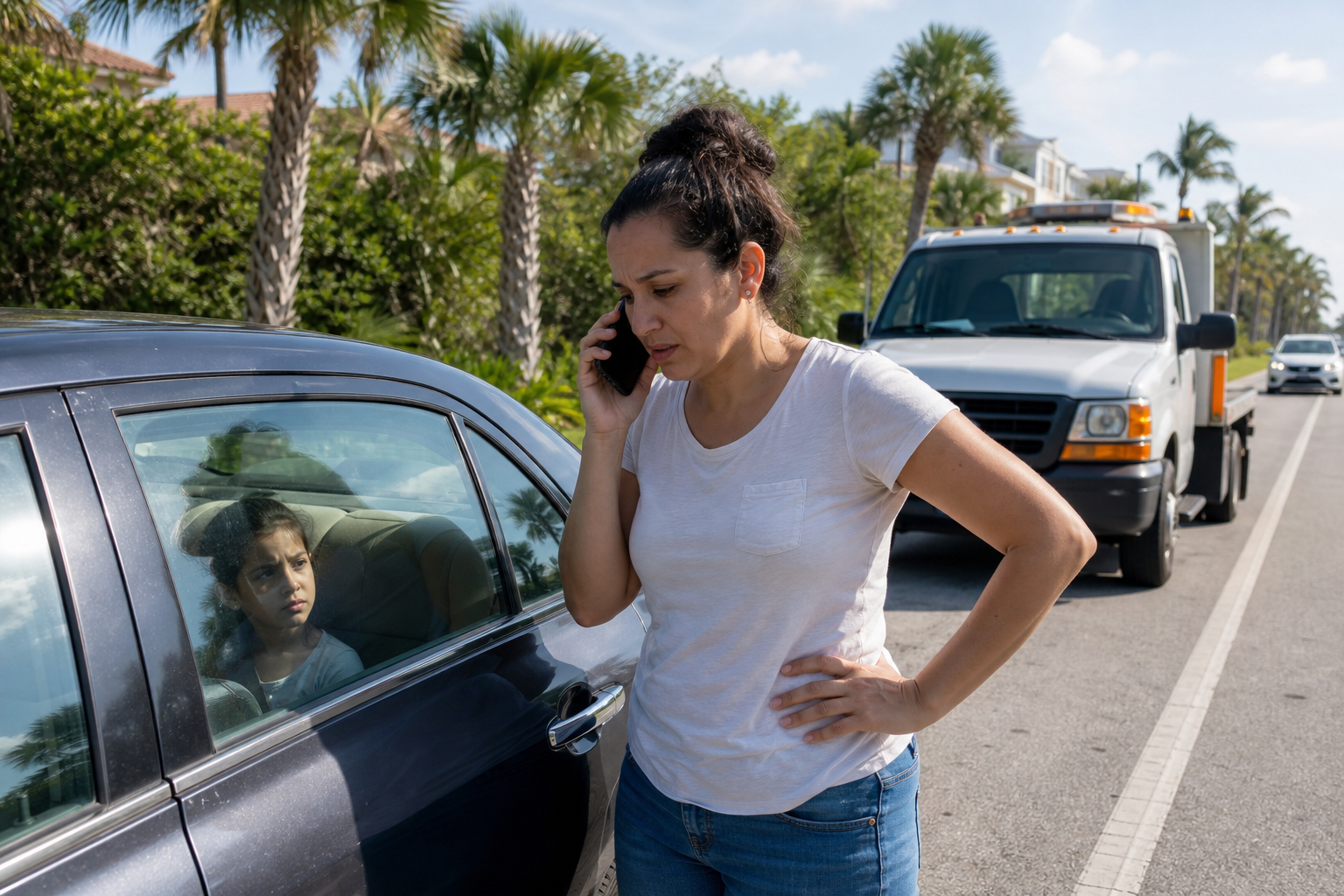
The highest-risk mistake is spending several minutes experimenting with coat hangers, wedges, phone apps, or repeated key-fob attempts while a child or pet remains inside. The safer alternative is to assess the occupant first, call 911 immediately when a child cannot exit or whenever distress is present, and use professional lockout assistance only when the situation is stable enough to wait.
Match the situation to the right response
| What you see | What to do now | Role for roadside assistance |
|---|---|---|
| A child is unable to unlock a door or follow a simple instruction. | Call 911. Remain beside the vehicle and follow dispatcher directions. | Do not make a routine lockout provider the first call. Roadside help can be considered only if emergency personnel indicate that it is appropriate. |
| A child or pet is limp, confused, vomiting, breathing abnormally, unusually quiet, frantic, or unresponsive. | Call 911 immediately. Describe the observed symptoms rather than simply reporting a lockout. | Wait for emergency instructions. Do not attempt improvised entry unless the dispatcher directs you. |
| A pet is alert and responsive, the cabin appears stable, and professional entry can be arranged without delay. | Call a lockout provider while continuously monitoring the pet. Escalate to 911 at the first change in behavior or if the wait becomes uncertain. | Car lockout service may provide controlled entry without the risks created by improvised tools. |
| An older child can clearly understand you and can safely reach a manual lock or door handle. | Give one calm, simple instruction. If the door does not open promptly, stop coaching and call 911. | Roadside service should not replace an emergency call when the child remains trapped or becomes upset. |
| The engine or climate control appears to be running. | Continue monitoring. Do not assume the system will keep operating or that the cabin is comfortable throughout the vehicle. | A stable pet lockout may still be handled by roadside assistance, but any uncertainty about the occupant overrides the service call. |
West Palm Beach conditions deserve a cautious threshold. Direct Florida sun, warm surrounding air, humidity, and heat reflected from pavement can increase cabin discomfort. Shade can shift, and a vehicle that felt tolerable moments earlier may not remain that way. The occupant’s condition—not the convenience of the unlock—is the deciding factor.
Stop self-help or continue with a lockout request?
Stop and use the emergency branch
- A child cannot exit without help.
- Either occupant shows a physical or behavioral warning sign.
- You cannot see the occupant clearly enough to assess the condition.
- You do not know how long the child or pet has been inside.
- The vehicle has stopped running, the climate system is uncertain, or conditions are becoming warmer.
- You feel unsure about whether waiting is safe.
In any of these situations, call 911 and follow the dispatcher’s instructions. Avoid breaking glass or forcing a door on your own. Flying glass, an unexpected door opening, and poorly chosen impact points can injure the occupant or the person attempting entry.
Continue with professional lockout help only when all conditions fit
- The occupant is a pet rather than a child who cannot self-exit.
- The pet is alert, breathing normally, and responding as expected.
- You can remain beside the vehicle with an unobstructed view.
- You have a working phone and can escalate immediately if anything changes.
- The provider understands that an animal is inside and confirms that the request can be handled as an active lockout.
If those conditions remain stable, request roadside assistance in West Palm Beach. A spare key may also solve the problem if another person can bring it promptly, but do not leave the vehicle to retrieve one.
Roadside checklist while help is being arranged
- Keep visual contact: Stand where you can see the occupant’s face and chest movement without creating a traffic hazard.
- Try normal entry once: Check each ordinary passenger door, the liftgate or trunk release if it provides cabin access, and the manufacturer’s normal remote-entry option. Stop after this single check.
- Use a calm voice: Reassure the child or pet. Do not encourage a child to climb around the cabin or handle vehicle controls.
- Watch for change: Note increasing agitation, reduced response, altered breathing, weakness, vomiting, or collapse. A change means switching from roadside service to 911.
- Protect access: Tell anyone bringing help which side of the vehicle is easiest to reach. Keep people from crowding the doors.
- Avoid improvised tools: Screwdrivers, wire, pry bars, and wedges can damage glass, wiring, seals, locks, or side-curtain airbag areas.
- Do not cancel too early: Keep the requested help active until a door is open and the occupant is safely out.
Prepare one clear service call
Give the roadside dispatcher the full situation at the beginning rather than spreading details across several calls. Use this compact script:
“I am locked out of a [year, make, model, and color] in West Palm Beach, Florida. A [child/pet] is inside. The occupant currently appears [alert, responsive, breathing normally—or describe symptoms]. The engine is [running/not running/unknown]. I am at [exact address, property name if visible, parking area, and nearest accessible entrance]. My callback number is [number].”
Also report whether the keys are visible inside, whether all doors are closed, and whether you have already called 911. Never describe a distressed occupant as a routine lockout; that information changes how the call should be handled.
If the vehicle is in a controlled parking area, tell the provider how to enter before arrival. Give only observable details. Do not estimate cabin temperature, promise that the air conditioning is working, or minimize symptoms to keep the request in a non-emergency queue.
After entry: drive, request roadside support, or tow?
Opening the door resolves the lockout, but it does not automatically mean the vehicle should be driven. First attend to the child or pet and follow any emergency instructions already given. Then check the vehicle for problems connected to the incident.
- Drive only if: the vehicle starts and operates normally, no warning indicator or overheating condition is present, the glass and doors are secure, and no entry attempt caused visible damage that could affect safe operation.
- Request additional roadside help if: the battery is depleted, the key or fob does not function after retrieval, or the vehicle will not start but is otherwise safely positioned.
- Choose towing instead of driving if: the vehicle is overheating, will not remain running, has damaged glass or a door that will not secure, displays a serious warning, or cannot be moved safely.
A provider handling the unlock can be told in advance if the engine has been idling, the battery may be weak, or the vehicle showed a warning before the lockout. That allows the call to be framed as more than entry alone. See vehicle towing options when the vehicle’s condition—not the lock—is what prevents a safe departure.
Lockout safety FAQs
What if my phone is locked inside too?
Ask a nearby person or an accessible business to call 911 for a trapped child or distressed pet. Give the vehicle description and exact West Palm Beach location, then return to a position where you can see the occupant.
Should I trust the dashboard or app showing that climate control is on?
Treat it as useful information, not proof of continued safety. Remote systems can disconnect, vehicles can shut down, and the dashboard does not show how the occupant feels. Visual monitoring remains necessary.
Can a lockout technician guarantee damage-free entry?
No entry method should be treated as a universal guarantee. Vehicle design, lock type, glass, door seals, and key technology differ. Providing the year, make, and model helps the service provider prepare an appropriate approach.
What if the doors open but the key fob no longer works?
Keep the child or pet safely out of the vehicle while you test normal starting procedures. If the vehicle will not start, request roadside help. If it cannot be made safe to operate, arrange a tow rather than repeatedly trying to drive it.
Choose the call by condition, not convenience
Child trapped, distress present, or safety uncertain: call 911 now. Pet alert and conditions stable: request professional lockout assistance and monitor continuously. Vehicle unsafe after entry: move from an unlock request to roadside support or towing before attempting to drive.